Centralized Culinary Utility: High-Efficiency Performance of the Kitchen Faucet
Source:https://m.media-amazon.com
Think about the last time you prepared a meal. You probably spent a good chunk of time chopping, sautéing, and plating. But if you actually track your movements, you’ll realize a fascinating truth: the absolute busiest spot in your entire home isn’t the stove, the fridge, or the couch. It’s a small, metallic lever right above your sink.
Over the past decade of remodeling homes and diagnosing plumbing headaches, I’ve watched homeowners happily drop thousands of dollars on commercial-grade ranges or smart refrigerators, only to treat their kitchen faucet as an afterthought. They pick whatever looks shiny on the showroom shelf.
It’s a classic mistake. In my experience, a poorly chosen faucet is the fastest way to turn a dream kitchen into a daily source of frustration. Let’s do a deep dive into the engineering, utility, and practical magic of high-efficiency kitchen faucets so you can upgrade your space like a seasoned pro.
Why the Kitchen Faucet is the Unsung Hero of Your Home
In the home improvement industry, we refer to the zone between the refrigerator, the stove, and the sink as the “work triangle.” If that triangle is the heart of the kitchen, then the kitchen faucet is its pulse.
The Ultimate Multi-Tasker
On any given day, this single fixture is responsible for hydrating your family, washing abrasive grime off root vegetables, blasting dried egg yolk off a skillet, and sanitizing your hands after handling raw poultry. It handles hundreds of cycles a week under variable water pressures and temperatures.
When you look at it through the lens of a centralized culinary utility, you stop seeing it as just a tap. It is a highly engineered mechanical valve designed to control fluid dynamics while matching the aesthetic DNA of your home.
Anatomical Deep-Dive: What’s Under the Hood?
To choose a high-efficiency fixture, you need to understand how it works. Think of a kitchen faucet like a performance vehicle. The exterior finish is just the paint job; what really matters is the engine beneath the chassis.
1. The Core: Ceramic Disc Cartridges
Older faucets used rubber washers to seal off water flow. Over time, these washers friction-wear, rot, and cause that agonizing, rhythmic drip-drip-drip that keeps you awake at night.
Pro Tip: Modern, high-efficiency fixtures utilize ceramic disc cartridges. These consist of two fire-hardened ceramic discs that slide across each other. They are nearly diamond-hard, completely impervious to mineral buildup, and effectively leak-proof for life. If a faucet doesn’t explicitly list a ceramic cartridge, walk away.
2. The Lungs: High-Efficiency Aerators
How does a modern fixture deliver a powerful, satisfying spray while actually using less water? The secret lies in the aerator, a small mesh screen screwed into the tip of the spout.
An aerator mixes air into the water stream. This maintains high water pressure and tactile force while restricting the overall flow rate (measured in Gallons Per Minute, or GPM). It’s the ultimate illusion: it feels like a torrential downpour, but your water bill reads like a drizzle.
3. Structural Integrity: Brass vs. Plastic
The internal waterways of a quality fixture should ideally be constructed from solid brass or specialized stainless steel. Cheaper, big-box store alternatives often use plastic internals coated in a metallic finish. They look identical on day one, but after two years of hot water exposure, those plastic components embrittle and crack.
Choosing Your Configuration: Form Meets High-Efficiency Function
When navigating the market, you’ll be hit with an overwhelming array of styles. Let’s break down the three most reliable configurations I install for clients looking for peak efficiency.
+-------------------+-----------------------------+------------------------------------+
| Faucet Type       | Best Used For               | Efficiency Level                   |
+-------------------+-----------------------------+------------------------------------+
| Pull-Down /       | Heavy cooking, large sinks, | High (Targeted spray patterns      |
| Pull-Out          | multi-tasking               | reduce water waste)                |
+-------------------+-----------------------------+------------------------------------+
| Commercial Pre-Rin| Industrial aesthetics,      | Maximum mechanical clearing force |
|                   | blasting stubborn debris    |                                    |
+-------------------+-----------------------------+------------------------------------+
| Touchless /       | Smart homes, hygiene,       | Ultimate conservation (Zero        |
| Motion-Activated  | multitasking chefs          | idle running time)                 |
+-------------------+-----------------------------+------------------------------------+
Pull-Down and Pull-Out Powerhouses
A pull-down faucet features a high-arch goose-neck spout where the spray head pulls straight down into the basin. A pull-out faucet has a shorter spout that pulls forward and out.
Both utilize an integrated spray wand on a flexible hose. This flexibility allows you to bring the water directly to the grime, rather than moving a heavy pot around a fixed stream. By targeting your rinsing, you finish the job faster and waste significantly less water.
Commercial Pre-Rinse Models
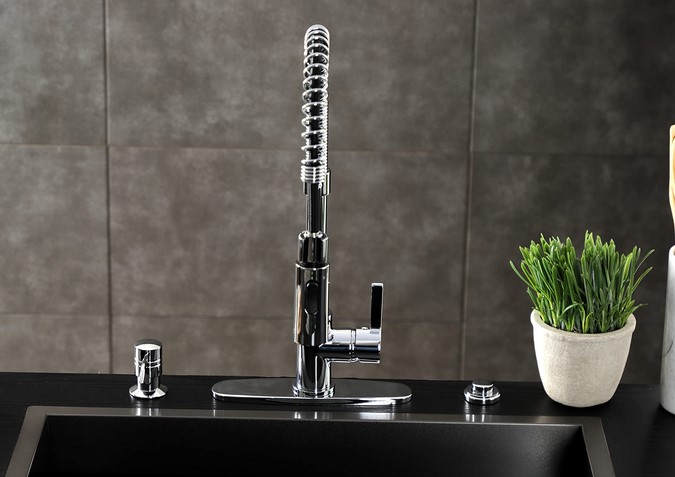
If you love the aesthetic of a professional restaurant kitchen, these are for you. They feature an exposed spring design and a high-pressure spray pattern. They excel at mechanical clearing, meaning they use sheer kinetic force to strip food particles off plates without needing excessive water volume.
Touchless and Motion-Activated Tech
Solids, grease, and raw meat juices on your hands make turning a manual handle a hygienic nightmare. Touchless kitchen faucets use infrared sensors to detect the presence of your hands or a pot.
-
The Efficiency Benefit: Think about how much water idles down the drain while you grab a towel or scrub a plate. Touchless tech cuts that idle time down to absolute zero.
Technical Specifications: Deciphering the Numbers
When shopping for your next kitchen faucet, don’t get distracted by the glossy lifestyle photos. Turn the box over and look at the technical data sheet. Here is what you want to find:
Flow Rates and GPM Standards
Standard faucets used to flow at 2.2 GPM. Today, high-efficiency models are engineered to operate beautifully at 1.8 GPM or even 1.5 GPM, often meeting strict certifications like EPA WaterSense.
-
The Math: Dropping from 2.2 to 1.5 GPM saves roughly 30% on your kitchen water consumption. Over a year of dishwashing, that adds up to thousands of gallons conserved.
Mounting Holes and Compatibility
Before buying, look under your sink to count the existing mounting holes in your countertop or sink deck.
-
1-Hole: Clean, minimalist, and standard for modern single-handle faucets.
-
3-Hole: Traditional setup for separate hot/cold handles and a central spout.
-
4-Hole: Usually accommodates an independent side-spray or soap dispenser.
Pro Tip: Don’t panic if you buy a single-hole faucet but have a three-hole sink. Look for a model that includes an escutcheon plate (deck plate). This baseplate neatly covers up the unused holes for a seamless look.
The Master Class: Installation and Maintenance Secrets
You don’t need a master’s degree in plumbing to install a new kitchen faucet, but you do need to avoid the common pitfalls that cause premature failure.
Watch the Water Supply Lines
When connecting your new fixture to the hot and cold shut-off valves, always opt for braided stainless steel supply lines. They are incredibly resilient against pressure spikes. When tightening the compression nuts, give them a solid turn with a wrench, but do not over-tighten—crushing the rubber gaskets inside will actually create a leak path.
Combatting Hard Water and Mineral Scale
If you live in an area with hard water, calcium and magnesium will eventually clog your aerator, causing an uneven, splashing stream.
Instead of using harsh chemicals that can ruin your faucet’s finish, use the baggy trick. Fill a small plastic bag with white vinegar, submerge the faucet aerator into it, and secure it with a rubber band. Let it sit for two hours. The mild acid will dissolve the scale, restoring your pristine water pressure instantly.
Conclusion: Investing in Your Daily Flow
At the end of the day, upgrading your kitchen faucet isn’t about luxury; it’s about optimizing the hardest working station in your home. By choosing a fixture with solid internal brass components, a ceramic disc cartridge, and a balanced, high-efficiency GPM flow rate, you save money on utilities while elevating your daily culinary workflow.
Stop wrestling with a leaking, sputtering, low-arc tap that can’t even fit your pasta pot underneath it. It’s time to bring your kitchen into the modern era of high-efficiency performance.
What style of faucet are you currently leaning toward for your kitchen upgrade? Are you tempted by the convenience of touchless tech, or do you prefer the rugged look of a commercial pre-rinse setup? Let me know in the comments below, and I’ll gladly help you troubleshoot your setup!