Space-Saving Organizational Branding: Implementing the Mug Hook Under-cabinet
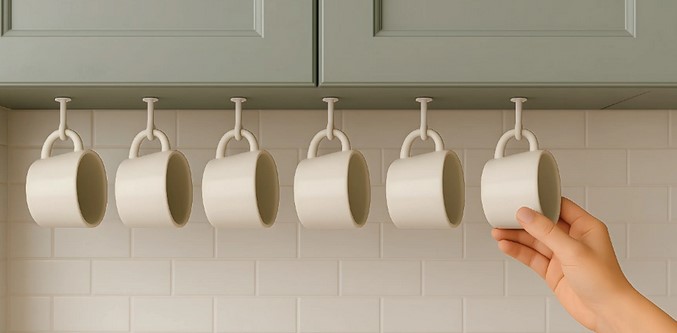
Source:https://www.fabuwood.com
Open your kitchen cabinets right now. Go ahead, I’ll wait. If you are anything like 90% of the homeowners I’ve visited over the past decade, you just faced a precarious, Jenga-like tower of ceramic coffee mugs. One wrong move, and your favorite souvenir cup from that weekend trip is history.
In my 10+ years as a home improvement expert, I have remodeled expansive luxury kitchens and tiny studio apartment galleys. Do you know what the universal enemy is across all of them? Clutter. Specifically, the kind of clutter that eats up prime eye-level real estate.
When your countertops are crowded and your cabinets are bursting, the kitchen stops being an inspiring culinary workspace and starts feeling like a storage locker. That is where the genius of the mug hook under-cabinet system comes into play. It is one of the most cost-effective, high-yield DIY upgrades you can make to reclaim your kitchen’s flow.
The Physics of Vertical Real Estate: Why Under-Cabinet Space Matters
In the remodeling world, we talk a lot about “dead space.” This refers to areas in a room that serve absolutely no functional purpose. The gap between the bottom of your upper cabinetry and your countertop is prime, untapped vertical real estate.
Why Cabinets Fail the Mug Test
Standard cabinet shelves are flat, horizontal planes. Mugs, however, are bulky, irregular cylinders with handles. When you stack them, you leave massive pockets of empty air above them, yet you completely exhaust the shelf’s surface area.
By implementing a mug hook under-cabinet layout, you shift your storage strategy from a base-supported system to a suspension-oriented system. Think of it like a coat rack for your caffeine addiction. You are taking advantage of gravity and utilizing space that was previously doing absolutely nothing for your home.
Anatomy of a Secure Hold: Selecting Your Hardware
Don’t just run to the nearest dollar store and buy the cheapest brass screw eyes you can find. A standard ceramic mug weighs between 12 to 16 ounces when empty. Multiply that by six or eight mugs, and you are hanging a significant amount of dead weight from a relatively thin piece of wood.
Types of Under-Cabinet Mug Organizers
When browsing hardware, you will generally run into three distinct options:
-
Individual Screw-In Hooks: Classic, minimalist, and highly customizable. You screw these directly into the cabinet base.
-
Slide-On Rack Tracks: These feature a flat metal bar with pre-spaced hooks that slides right over the bottom shelf of your cabinet. They require zero drilling, making them perfect for renters.
-
Screw-Mounted Rail Systems: A heavy-duty metal track that anchors into the cabinet underside with multiple screws. This is the gold standard for durability.
+--------------------------+----------------------------+----------------------------+
| System Type              | Ideal For                  | Installation Difficulty    |
+--------------------------+----------------------------+----------------------------+
| Individual Screw Hooks   | Custom spacing, light mugs | Beginner (Basic tools)     |
+--------------------------+----------------------------+----------------------------+
| Slide-On Racks           | Renters, zero-damage needs | Absolute Novice (No tools) |
+--------------------------+----------------------------+----------------------------+
| Screw-Mounted Rails      | Heavy ceramics, permanence | Intermediate (Drill req.)  |
+--------------------------+----------------------------+----------------------------+
Material Quality and Grip Coatings
Look for hooks forged from hardened carbon steel or industrial stainless steel. I always recommend opting for hooks with a vinyl or rubberized coating.
The coating acts as a shock absorber. When you are groggily reaching for a cup at 6:00 AM, the rubber prevents the ceramic handle from clinking harshly against bare metal, saving your mugs from micro-cracks and chips.
Step-by-Step Guide: Installing a Mug Hook Under-cabinet System
Let’s roll up our sleeves. If you are going the permanent route with a screw-mounted rail or individual hooks, you need a precise game plan to avoid ruining your expensive cabinetry.
Step 1: Assess Your Cabinet Anatomy
Before drilling a single hole, you must measure the thickness of your cabinet’s bottom panel (the deck). Most standard modular cabinets have a bottom deck that is $\frac{1}{2}$ inch to $\frac{3}{4}$ inch thick.
This is where amateur DIYers break their hearts. If your screw length matches or exceeds the thickness of the cabinet floor, the tip of the screw will pierce right through into the inside of your cabinet, leaving a sharp, ugly metal point that will ruin your dishes. Ensure your fastener length is at least $\frac{1}{8}$ inch shorter than the total wood thickness.
Step 2: Map Out the Stagger and Clearance
Mugs don’t hang like flat sheets of paper; they bulb outward. If you place your hooks too close together, the mugs will smash into each other, preventing them from hanging straight.
-
Measure the diameter of your widest mug.
-
Add 1 to 1.5 inches of clearance to that measurement. This is your ideal center-to-center hook spacing.
-
Mark your layout on a strip of painter’s tape stuck to the underside of the cabinet. This allows you to visualize the placement without marking up the wood finish.
Step 3: Drilling the Pilot Holes
Never try to force a screw hook straight into finished cabinetry without a pilot hole. You risk splitting the wood grain or snapping the head off the screw.
Using a drill bit slightly narrower than the inner shank of your screw hook, drill straight up into your marked locations. Wrap a piece of painter’s tape around your drill bit to act as a depth stop so you don’t accidentally drill too deep. Once your pilot holes are set, twist your hooks in until the collar sits flush against the wood surface.
Organizational Aesthetics: Branding Your Kitchen Space
Beyond the undeniable structural and spatial benefits, a mug hook under-cabinet installation serves as a powerful piece of visual “branding” for your home. It transitions your kitchen from looking like a chaotic utility room to a curated, artisanal coffee bar.
Color-Coding and Symmetry
When your mugs are hidden away behind closed cabinet doors, visual consistency doesn’t matter. But the moment you hang them out in the open, they become part of your room’s decor.
Try arranging your mugs by color gradient, or select a uniform set of cups that match your kitchen’s accent colors. Hanging them neatly creates an intentional focal point that draws the eye across the room, making a small kitchen feel noticeably wider and more styled.
Long-Term Maintenance: Keeping Your Setup Secure
Over months of daily use, the repeated action of pulling mugs off and hanging them back up can put vibrational stress on the mounting points.
Every six months, do a quick safety check. Give each hook a gentle wiggle. If a screw-in hook begins to feel loose, don’t just tighten it into the same worn-out hole.
Remove the hook, pack the hole with a sliver of toothpick dipped in wood glue, let it dry, and re-drive the screw. This restores the wood density, ensuring your favorite mugs remain completely secure above your counters.
Reclaim Your Workspace Today
Upgrading your kitchen doesn’t require a five-figure demolition budget. True home improvement is found in the smart, incremental details that resolve daily friction. By utilizing a mug hook under-cabinet configuration, you clear out cabinet gridlock, free up essential workspace, and give your kitchen a clean, organized aesthetic.
Are you dealing with an overflowing coffee cup collection right now? What style of mugs are you planning to display on your new under-cabinet setup? Drop a comment below, and let’s map out your next weekend project!