Maximizing Real Estate Footprint: Creative Implementation of Attic Playroom Ideas
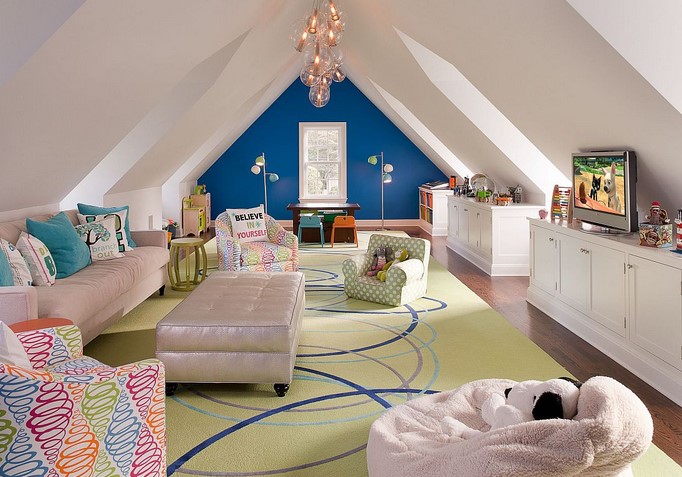
Source:https://cdn.decoist.com
Your kids are growing, the Lego sets are colonizing the living room like a plastic invasive species, and you’re staring at your floor plan wondering where all the “home” went. Most homeowners look toward expensive ground-floor extensions or moving to a bigger house, but they forget to look up. Right above your head sits 400 to 600 square feet of dusty, unconditioned “dead air” that is currently doing nothing but storing holiday decorations.
In my fifteen years of structural consulting, I’ve seen attics transformed from dark spider-havens into the most coveted rooms in the house. When we talk about Attic Playroom Ideas, we aren’t just talking about throwing a rug over some plywood; we are talking about a strategic “vertical reclaim” of your property’s value. It is the most cost-effective way to increase your usable square footage without changing the footprint of your home.
The “Third Floor” Secret: Why the Attic is Your Best Asset
In high-end residential branding, the “Bonus Room” is a major selling point. But for a playroom specifically, the attic is perfect because it’s geographically isolated. It’s the only place in the house where the sound of a drum kit or a high-decibel play-date won’t vibrate through the kitchen ceiling while you’re trying to have a professional call.
I remember a project for a family of four who felt they had “outgrown” their cottage. Instead of listing the house, we opened the attic hatch. By navigating the Attic Playroom Ideas that prioritize head-height and natural light, we created a “Narnia-style” retreat. The kids got a fortress, and the parents got their living room back. It wasn’t just a renovation; it was a sanity-saver.
Think of an attic conversion like fitting a custom suit to a growing child. The “frame” of the suit (the roofline) is already there; you just need to tailor the lining (insulation) and the hem (flooring) to make it functional.
Engineering the Safe Zone: Technical Specs for Success
Converting an attic is vastly different from finishing a basement. You are dealing with heat rising, structural load limits, and strict building codes.
1. The “Live Load” vs. “Dead Load”
Most attics are engineered for “Dead Loads”—meaning they can hold the weight of the roof and a few boxes. A playroom requires a “Live Load” capacity (usually 30-40 lbs per square foot).
-
Joist Check: If your attic floor consists of 2×4 or 2×6 joists, they are likely too weak. We often “sister” the joists, attaching new 2×8 or 2×10 lumber alongside the old ones to stiffen the floor.
-
Deflection: You don’t want the floor to bounce. If your floor has “give,” it will crack the drywall on the ceiling of the room below.
2. Climate Infrastructure and R-Value
The attic is the hottest place in summer and the coldest in winter.
-
Closed-Cell Spray Foam: This is my go-to recommendation for playroom attics. It provides a high R-value (thermal resistance) while also acting as a structural adhesive for the roof deck.
-
Mini-Split Systems: Don’t try to tap into your existing HVAC; it likely isn’t sized for the extra volume. A ductless mini-split allows for independent temperature control.
3. Essential LSI Keywords to Know:
-
Egress Window: A window large enough for emergency exit, required by most fire codes.
-
Knee Walls: Short vertical walls (usually 3-4 feet high) that join the floor to the sloping roof.
-
Collar Ties: Horizontal beams that prevent the roof from “spreading” under its own weight.
-
Headroom Requirement: Most codes require at least 50% of the room to have a 7-foot ceiling height.
Creative Implementation: Turning Slopes into Features
The “sloped ceiling” is often seen as a problem, but in the context of Attic Playroom Ideas, it’s a design goldmine.
-
The Nook-and-Cranny Strategy: Use the low-clearance areas under the eaves for “reading burrows” or built-in toy bins. Kids love small, enclosed spaces that feel like their own secret headquarters.
-
Sky-Gazing Stations: Installing Skylights or Velux windows doesn’t just add light; it adds a sense of “height.” It makes a small attic feel like an observatory.
-
The “Secret Passage” Wardrobe: If you have extra space behind the knee walls, create a small door leading to a “hidden” carpeted tunnel. It’s the kind of detail that makes a childhood home legendary.
Expert Advice: The “Hidden Warning” of Sound Dampening
Pro Tip: The Impact Noise Paradox
You can have the most beautiful attic in the world, but if you don’t address the floor, every time your child jumps, it will sound like a thunderclap in the master bedroom below.
Peringatan Tersembunyi (Hidden Warning): Standard subflooring is a drum. To fix this, use Mass Loaded Vinyl (MLV) or a “Green Glue” dampening compound between two layers of subfloor. The Best Solution: Use thick rubberized underlayment beneath a high-quality “Soft-Touch” carpet. This absorbs the “impact noise” of running feet before it hits the joists.
The “Real Estate” ROI: Why It Pays Off
When you convert an attic into a finished playroom, you aren’t just adding a room; you are “graduating” your home to a higher price bracket. Appraisers look for “finished square footage.” By following legal egress and height codes, that dusty attic becomes “Living Area.”
In many markets, the return on investment (ROI) for an attic conversion is between 60% and 75%, but the functional ROI for a growing family is 100%. You are utilizing the “air” you already own.
Analogy: The “Horizontal” vs. “Vertical” Expansion
Imagine you have a full glass of water. If you want more water, you can buy a wider glass (a ground-floor extension), which takes up more space on the table (your yard). Or, you can just get a taller glass.
Attic Playroom Ideas allow you to “stack” your lifestyle. You get the extra volume without sacrificing your garden, your setback limits, or your driveway. It’s the most efficient use of “vertical real estate” available to a homeowner.
Maintenance: The “High-Altitude” Checklist
-
Check for Leaks: Before you hang drywall, wait for a heavy rain. Check every roof penetration (vents, chimneys) for dampness. Once the drywall is up, a small leak becomes a massive mold problem.
-
Ventilation: Ensure your “Soffit Vents” aren’t blocked by insulation. The roof still needs to “breathe” to prevent ice dams in winter.
-
Access Safety: If you’re using a pull-down ladder, upgrade it to a permanent staircase if space allows. It’s safer for kids and adds more value to the home.
Conclusion: The Sky is Literally the Limit
Reclaiming your attic is an act of residential bravery. It requires navigating technical codes and structural challenges, but the result is a unique, magical space that standard rooms simply can’t replicate. By applying these Attic Playroom Ideas, you are turning “forgotten space” into “found space.”
Stop looking at your cluttered attic as a burden. Look at it as the key to your home’s next chapter. It’s time to move the Legos upstairs and reclaim your living room.
Is your attic currently just a storage space for old boxes, or are you worried about the ceiling height being too low? I’ve helped homeowners navigate some incredibly tight roof pitches! If you tell me your roof’s “rise and run,” I can help you visualize a floor plan that maximizes every inch of that slope. Would you like me to create a “Structural Feasibility Checklist” for your specific attic type?