Electrical Safety Protocols: Real-Time Detection via the Non-Contact Voltage Pen
October 30, 2026
No Comments
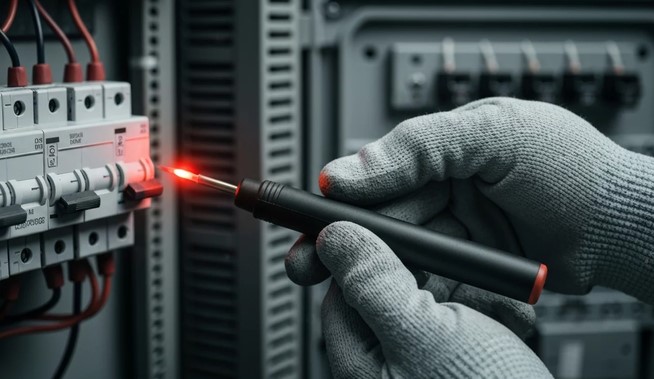
Source:https://cdn.expertce.com
You are standing on a stepladder in your hallway at 7:00 PM, preparing to replace an aging light fixture. You flipped the breaker marked “Hallway,” touched the plastic switch housing, and assumed the line was completely dead. As you loosen the wire nut and your pliers glance near the bare copper connection, a blinding blue arc snaps across the junction box with a loud crack. Your heart hammers against your ribs, your teeth chatter, and your arm goes numb.
In my ten-plus years of residential rewiring and electrical safety auditing, I have seen mislabeled breaker panels, shared neutral lines, and rogue hot legs send seasoned DIYers and apprentice technicians to the emergency room. According to home safety data, thousands of preventable shock injuries occur every year simply because someone assumed a circuit was dead without verifying it.
That heart-stopping shock could have been completely avoided in three seconds with a simple, twenty-dollar safety device tucked into your shirt pocket: the non-contact voltage pen.
The Physics of Safety: How a Non-Contact Voltage Pen Works Without Exposed Metal
Many homeowners are initially hesitant to trust a tester that does not make direct physical contact with bare copper wire like traditional multimeter probes. How can a plastic-tipped tool accurately determine whether lethal electrical current is flowing through an insulated cable?
A non-contact voltage pen—often called an NCVT or voltage sniffer—operates on the physical principle of capacitive coupling. When alternating current (AC) flows through a hot conductor, it generates a localized, pulsing electromagnetic field around the wire that radiates through the plastic insulation.
 [ AC Live Wire Conductor ] ──► Generates Electromagnetic Field
              │
              ▼
   [ PVC Cable Insulation ]  ──► Field Radiates Through Plastic
              │
              ▼
 [ Non-Contact Voltage Pen ] ◄── Sensor Tip Detects Field
              │
              ▼
  [ Red LED & Audible Alarm ] ◄── Circuit Triggers Real-Time Warning
Think of the pen’s internal sensor tip like a miniature, highly sensitive radio antenna. You do not need to strip the insulation or touch bare copper; as long as the sensor enters the active electromagnetic field, the pen completes a high-impedance internal circuit, instantly triggering a bright red LED and an audible alarm.
The “Live-Test-Live” Protocol: The Gold Standard for Electrical Verification
Owning a non-contact voltage pen is only half the battle; knowing how to execute a systematic safety protocol is what keeps you out of the hospital. In professional trade work, we strictly enforce the 1-2-3 Live-Test-Live protocol before placing a finger inside any junction box or switch cavity.
┌─────────────────────────────────────────────────────────┐
│              THE 1-2-3 LIVE-TEST-LIVE PROTOCOL           │
└─────────────────────────────────────────────────────────┘
  1. Test pen on a KNOWN LIVE outlet or cord.
  2. Test pen on your TARGET UNPOWERED circuit wires.
  3. Re-test pen on the KNOWN LIVE outlet to confirm tool life.
Never trust a tester blindly without verifying that its internal battery, LED, and sensor board are functioning right before and after your measurement:
-
Step 1: Validate on a Known Live Source: Touch the tip of your non-contact voltage pen to an outlet, lamp cord, or powered strip that you know is actively energized. Confirm that both the light and sound indicators trigger immediately.
-
Step 2: Test the Target Circuit: Place the pen tip directly against every wire, wire nut, switch terminal, and box side in your target area. Test neutral and ground wires as well, as shared neutral circuits can carry dangerous return currents.
-
Step 3: Re-Validate on the Known Live Source: Touch the pen back to your known live power source. This step confirms that the pen’s batteries did not die or suffer an internal failure while you were walking from the breaker box to the work site.
Decoding CAT Ratings: Choosing the Right Non-Contact Voltage Pen
Not all testers are engineered for the same electrical environments. When selecting a non-contact voltage pen, looking at the stamped Category (CAT) Rating on the casing is far more important than brand name or color.
CAT ratings define the tool’s structural ability to withstand sudden voltage spikes and transient surges without exploding or short-circuiting in your hand.
Dual-Range vs. Single-Range Sensitivity
Standard single-range testers typically detect voltages between 90V and 1000V AC, which is perfectly suited for standard 120V wall outlets and 240V appliance lines. However, modern dual-range models can toggle down to a low-voltage detection window of 12V to 1000V AC.
This lower sensitivity threshold allows you to troubleshoot low-voltage landscape lighting, smart doorbell transformers, HVAC control wiring, and thermostat circuits effortlessly.
| CAT Rating | Max Transient Voltage | Recommended Application Environment |
| CAT II | 2,500V Peak Surge | Portable tools, plug-in household appliances, standard wall outlets |
| CAT III | 4,000V Peak Surge | Residential distribution panels, hardwired switches, junction boxes |
| CAT IV | 8,000V Peak Surge | Utility service entrances, outdoor drop lines, electric meter bases |
Expert Advice: Field Insights and Critical Pitfalls
Throughout my decade inspecting residential electrical installations, I have documented several crucial field variables that can mislead an inexperienced homeowner.
1. Pro-Tip: Identifying “Phantom Voltage”
Occasionally, your non-contact voltage pen will beep continuously on a wire that you know is disconnected at the main panel. You are likely dealing with phantom voltage (or ghost voltage).
When a dead wire runs parallel to an active hot wire inside the same cable sheath over a long distance, the active wire’s electromagnetic field induces a small static charge into the dead line. While this residual charge lacks the current capacity to shock you, it is enough to trip a sensitive detector. If you suspect phantom voltage, verify the circuit using a digital multimeter set to low-impedance mode (LoZ).
2. Pro-Tip: The Metal Shielding Blind Spot
A non-contact voltage pen cannot detect electromagnetic fields through metal. If you are working on older armored cable (BX), metal conduits (EMT), or metal-enclosed junction boxes, the metallic outer sleeve blocks the field entirely. You must position the pen tip directly at the exposed wire ends or inside the open box entry point to get an accurate reading.
⚠️ Hidden Warning: The Thick Insulation & Dead Battery Trap
Inexpensive testers without a dedicated low-battery indicator light can fail silently, leaving you with a dark tip on a live 120V line. Always opt for testers with continuous self-test features. Additionally, extra-thick rubber extension cords or underground direct-burial cables (UF-B) can dampen electromagnetic fields, requiring you to press the pen tip firmly against the cable or switch to a high-sensitivity mode.
Electrical maintenance demands respect, deliberate procedures, and reliable diagnostic tools. By making the non-contact voltage pen a mandatory part of your safety kit and sticking strictly to the Live-Test-Live verification protocol, you eliminate dangerous guesswork and protect yourself from unexpected electrical hazards.
What electrical safety tools do you currently keep in your home toolkit, or have you ever encountered a mislabeled circuit breaker during a project? Share your experiences or technical questions in the comments below—I would love to help you stay safe on your next build!